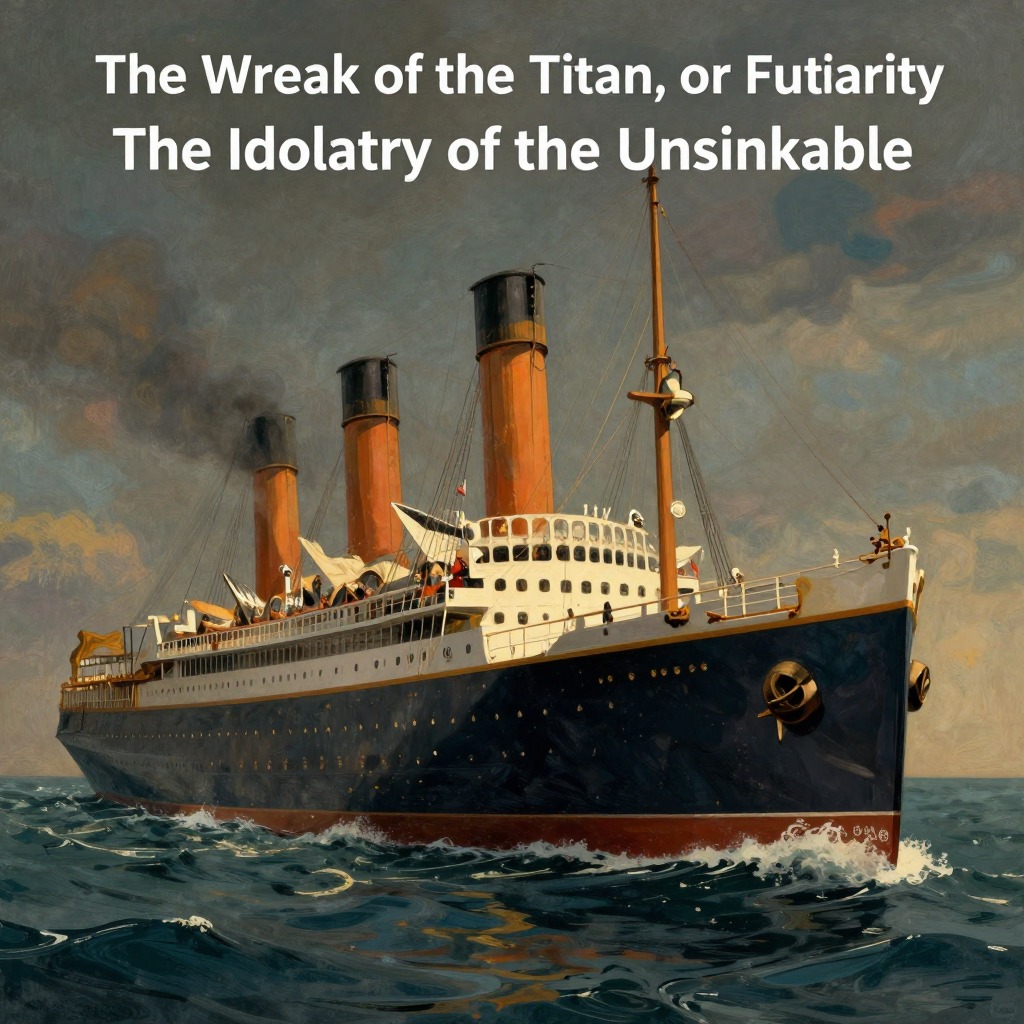
The floating city
The floating city is the epithet Morgan Robertson's novella The Wreck of the Titan applies to the steamship Titan, the largest and most technologically advanced vessel of its time. The phrase encapsulates the ship's role as a self-contained world of luxury, science, and presumed invincibility, and it becomes bitterly ironic when the Titan—declared unsinkable—sinks on its third return voyage after colliding with an iceberg. The expression underscores the central themes of technological hubris and the fragility of human achievement.
Definition and Description
The Titan is introduced as "the largest craft afloat and the greatest of the works of men," a floating city that contains within its steel walls "all that tends to minimize the dangers and discomforts of the Atlantic voyage—all that makes life enjoyable." The ship is eight hundred feet long, with a displacement of seventy thousand tons and seventy-five thousand horsepower, and on its trial trip it steamed at twenty-five knots an hour. Built of steel throughout and designed for passenger traffic only, it carries no combustible cargo, and its sharp dead-rise—the slant from the keel—improves its behavior in a seaway. The vessel is equipped with two brass bands, two orchestras, and a theatrical company to entertain passengers, a corps of physicians for their physical welfare, and a corps of chaplains for their spiritual welfare. A well-drilled fire-company soothes nervous passengers with daily practice. The ship's bridge is connected by hidden telegraph lines to the bow, stern engine-room, crow's-nest, and all parts of the ship, each wire terminating in a marked dial with a movable indicator, eliminating the hoarse shouts of officers and sailors.
The Illusion of Unsinkability
The floating city is built around a central claim of invincibility. Ninety-two doors of nineteen water-tight compartments can be closed in half a minute by turning a lever, and they also close automatically in the presence of water. With nine compartments flooded, the ship would still float, and so no known accident of the sea could possibly fill this many; the Titan is considered practically unsinkable. The company announces a rule of navigation that the ship will steam at full speed in fog, storm, and sunshine, on the Northern Lane Route, winter and summer. The reasons given are that at full speed the force of an impact would be distributed over a larger area, that the Titan would cut another craft in two with no more damage than a paintbrush could remedy, that at full speed she could be more easily steered out of danger, and that in an end-on collision with an iceberg—the only thing afloat she could not conquer—her bows would be crushed in but a few feet further, flooding at most three compartments, which would not matter with six more to spare. The ship carries only twenty-four lifeboats, securely covered and lashed down, which would hold five hundred people, and each of the three thousand berths contains a cork jacket, while about twenty circular life-buoys are strewn along the rails.
The Disaster and Its Irony
The floating city's presumed invincibility is shattered when the Titan, charging through fog at full speed, strikes an iceberg. The impact is not against a perpendicular wall but a low beach, and the ship rises out of the sea, heels, and crashes down on her side. The holding-down bolts of twelve boilers and three triple-expansion engines snap, and the giant masses of steel and iron puncture the sides of the ship, filling the engine and boiler-rooms with scalding steam, which brings a quick, though tortured, death to each of the hundred men on duty in the engineer's department. The Titan moves slowly backward and launches herself into the sea, floating low on her side, "a dying monster, groaning with her death-wound." The narrator describes the ship as "the invincible Titan, with nearly all of her people, unable to climb vertical floors and ceilings," beneath the surface of the sea. The phrase "floating city" thus becomes a bitter irony: the city that was supposed to be unsinkable sinks, and the very features that made it a floating city—its size, its speed, its water-tight compartments—contribute to the catastrophe.
Thematic Significance
The floating city serves as a symbol of technological hubris and the limits of human mastery over nature. The ship is a microcosm of society, with its officers, scientists, physicians, chaplains, and entertainers, and its destruction represents the collapse of that ordered world. The novella critiques the industrial and commercial pressures that prioritize speed and profit over safety, as the company's rule of full speed in fog is driven by the belief that the ship is indestructible. The phrase also carries a sense of isolation and self-containment: the Titan is a world unto itself, and when it sinks, that world is lost. The floating city is thus both a marvel of human achievement and a monument to human folly, and its fate foreshadows the real-life disaster of the Titanic, which Robertson's novella is often credited with predicting.